Leash reactivity happens when a dog barks, lunges, or growls at other dogs, people, or moving objects while on a leash. It is usually driven by fear, frustration, or over-excitement, not aggression. Most dogs improve with consistent counterconditioning and distance management over 8 to 16 weeks.
If your dog turns into a different animal the moment a leash goes on, you are not alone. Leash reactivity is one of the most common behavior complaints trainers hear. It rarely means your dog is bad or dangerous. This guide explains why it happens and exactly how to stop leash reactivity in dogs using proven, force-free methods.

Why Dogs Become Leash Reactive
A leash removes a dog’s ability to create distance from something scary. When dogs cannot flee, many switch to the next option: making the scary thing go away with noise and movement. This is called barrier frustration or leash frustration.
Reactivity can also come from under-socialization, a past bad experience with another dog, or simple over-arousal. A dog that loves other dogs but cannot control its excitement may bark and lunge out of frustration, not fear. The triggers look the same from the outside, but the emotion underneath is different.
Genetics play a role too. Herding and guarding breeds are often more prone to reactivity because they are wired to notice and respond to movement. Limited exposure to other dogs during the critical socialization window, roughly 3 to 14 weeks of age, can also raise the odds of reactivity later in life.
None of these causes mean your dog cannot improve. They just tell you which strategy will work best. A frustrated greeter needs different handling than a fearful dog, so an accurate read on the root cause makes training faster and less frustrating for both of you.
How to Stop Leash Reactivity: Step-by-Step
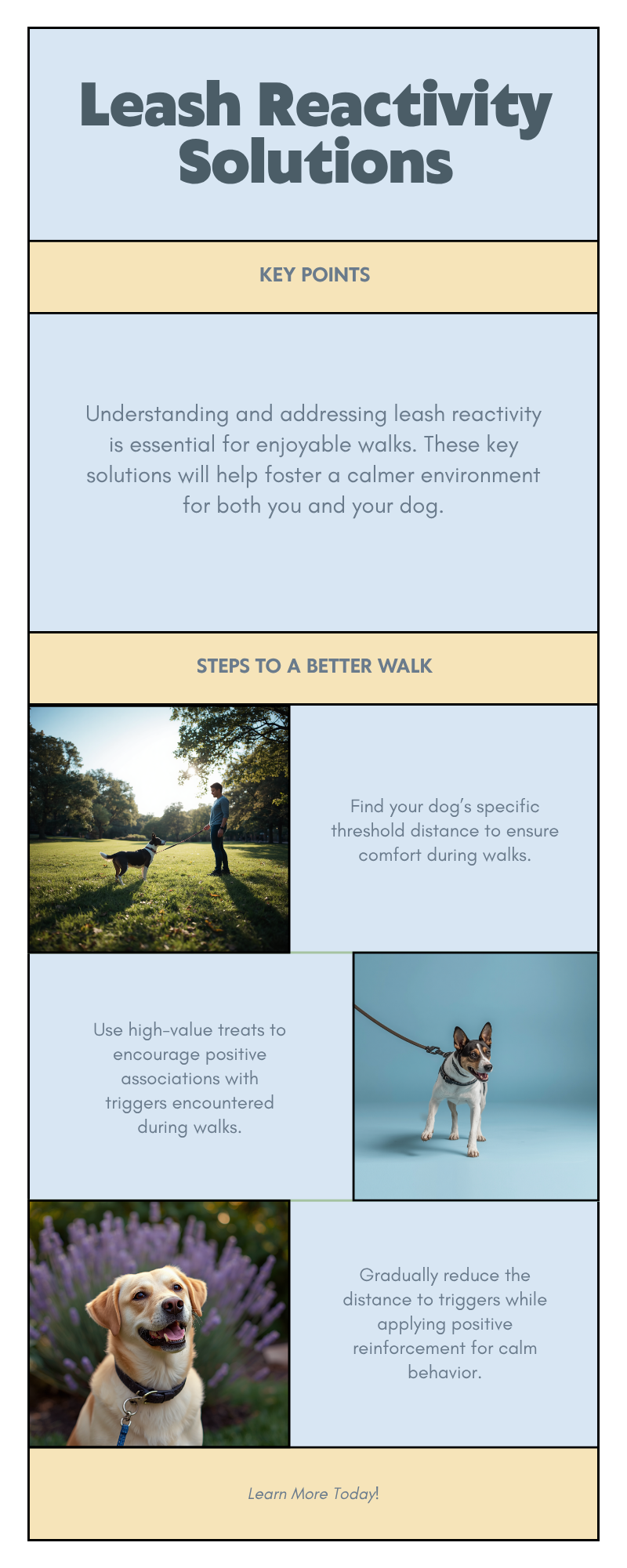
Step 1: Find Your Dog’s Threshold Distance
Every reactive dog has a distance at which they notice a trigger but can still think and respond to you. This is called the threshold distance. Walk your dog toward a known trigger, such as a parked dog. Note the distance where ears perk up but barking has not started yet.
Training only works below the threshold. If your dog is already barking and lunging, you are too close. Back up until your dog can look at you and take treats calmly.
Step 2: Pair the Trigger With Something Great
This is counterconditioning. Every time your dog notices a trigger at a safe distance, feed a high-value treat right away, like small pieces of chicken or cheese. The goal is to build a new association: trigger appears, good things happen.
Timing matters more than treat quality. Mark the moment your dog looks at the trigger with a clicker or a verbal yes, then feed within one to two seconds.
Step 3: Shrink the Distance Gradually
Once your dog stays relaxed at one distance across several sessions, move a few feet closer and repeat. This process, called systematic desensitization, should feel slow. Rushing it is the single biggest reason training stalls.
Expect progress in small steps over several weeks, not days. A dog that has practiced reactive behavior for months or years needs time to build a new habit.
Step 4: Teach an Emergency U-Turn
Sometimes a trigger appears too close or too fast for a training setup. Teach a cue like lets go paired with turning and walking the other direction. Practice this in low-distraction settings first so it becomes automatic under stress.
A reliable U-turn protects your dog from rehearsing the reactive response. Every repetition of barking and lunging makes the habit stronger.
What to Expect: Realistic Timeline
Mild reactivity often improves within 4 to 8 weeks of consistent practice. Moderate to severe cases, especially with a long history, can take 3 to 6 months or longer. Dogs rarely become fully cured in the sense of never reacting again. Instead, most become manageable: fewer outbursts, faster recovery, and better response to cues near triggers.
Reactive Dog Training Checklist
- Identify specific triggers (dogs, bikes, joggers, strangers)
- Find and record your dog’s threshold distance
- Stock high-value treats before every walk
- Practice the U-turn cue in a quiet space first
- Track sessions to confirm gradual progress
- Avoid dog parks and crowded trails during training
- Consult a certified trainer if progress stalls after 6-8 weeks
Common Mistakes
- Getting too close too fast. Pushing past threshold distance causes your dog to rehearse the reactive behavior instead of learning a new one.
- Using punishment or leash corrections. Startling or correcting a fearful dog usually increases anxiety and can worsen reactivity over time.
- Skipping foundational skills. A dog that does not know a solid look-at-me or recall in a quiet room will not perform it near a trigger.
- Inconsistent practice. Training once a week rarely builds a new habit. Short, frequent sessions work better than occasional long ones.
- Ignoring the dog’s body language. Stiff posture, a tucked tail, or a closed mouth often signal stress before barking starts.
Expert Tips
- Walk during quieter hours to control trigger exposure while you build skills.
- Use a front-clip harness for better control without adding neck pressure.
- Keep training sessions under 15 minutes to avoid mental fatigue.
- Celebrate small wins, like a quick glance at you instead of a lunge.
- Consider a certified professional dog trainer or veterinary behaviorist for moderate to severe cases.
Frequently Asked Questions
Is leash reactivity the same as aggression?
No. Most leash reactivity comes from fear or frustration, not a genuine desire to fight. True aggression is less common and usually involves other warning signs. A professional evaluation can help tell the two apart.
Can leash reactivity be fully cured?
Many dogs improve significantly, but full elimination of the behavior is not guaranteed. The realistic goal is a dog that recovers quickly and responds to cues, even if occasional reactions still happen.
Should I use a muzzle during training?
A properly fitted basket muzzle can add safety during training, especially in public spaces, and does not cause discomfort when introduced correctly. It does not replace training and should be used alongside, not instead of, a behavior plan.
Does the type of leash or harness matter?
Yes. A short, sturdy leash and a well-fitted front-clip harness give you more control without adding pressure to your dog’s neck. Retractable leashes make it harder to manage distance quickly, so they are not a good fit for reactivity training.
When should I call a professional trainer?
Reach out to a certified trainer or veterinary behaviorist in three cases: reactivity involves biting, progress stalls after 6 to 8 weeks, or the behavior is getting worse.
Summary
Leash reactivity is common and treatable with patience and the right method. Find your dog’s threshold distance, pair triggers with high-value rewards, and shrink distance gradually over weeks, not days. Avoid punishment-based corrections, since they tend to increase fear and worsen the behavior.
If progress stalls or the behavior involves biting, a certified trainer or veterinary behaviorist can help build a safe, structured plan. For more on positive training methods, see the American Kennel Club.
PawLife is written and edited by a dog owner who researches every topic using veterinary and canine-behavior sources (AKC, AVMA, ASPCA) before publishing. We are not veterinarians — this article is for general information only and is not a substitute for professional veterinary advice. Always consult your vet about your dog's specific health or behavior needs. Learn more about us.